South Korea’s crypto market is no longer the Wild West it was before July 25, 2024. On that date the Virtual Asset User Protection Act (VAUPA) took full effect, forcing every Korean exchange to segregate customer assets, buy deposit insurance, and re-register with the Korea Financial Intelligence Unit. Two survivors dominate the Korean Won (KRW) order book: Upbit, the Dunamu-operated giant that has held ~80% of KRW fiat volume for years, and Bithumb, the resurgent number two fighting back on fees and altcoin access. This comparison breaks down where each actually wins for Korean traders in 2026 — on liquidity depth, VAUPA compliance posture, custody, and real cost of trading KRW pairs.
Upbit
Dunamu Inc. · Est. 2017 · Seoul
~80.4%KRW market share (2026 Q1)
KFIU-registered · KDIC insured
230+ KRW pairs · 0.05% / 0.25%
Bithumb
Vidente-controlled · Est. 2014 · Seoul
~9.8%KRW market share (2026 Q1)
KFIU-registered · KDIC insured
180+ KRW pairs · 0.04% / 0.25%
⚡ The Quick Verdict
For a Korean resident trading in Korean Won, Upbit remains the structurally safer and deeper venue in 2026: it commands roughly 80% of KRW fiat volume, runs the deepest KRW order books in the country, and has a clean VAUPA compliance record with full customer-asset segregation at Kookmin Bank and KDIC deposit insurance up to 5 million KRW per user. Bithumb wins on two narrow but real axes — a marginally lower maker fee (0.04% vs 0.05%) and a more aggressive altcoin listing policy — making it the better pick for cost-sensitive active traders who want the longest KRW altcoin tail inside a fully regulated wrapper. Neither serves futures or derivatives to Korean residents under VAUPA, so leveraged traders must look offshore (see our Bybit review or OKX vs Bybit comparison). For the full platform breakdown, see our dedicated Upbit exchange review.
Why this comparison matters now: Korea’s 2024 VAUPA regime change
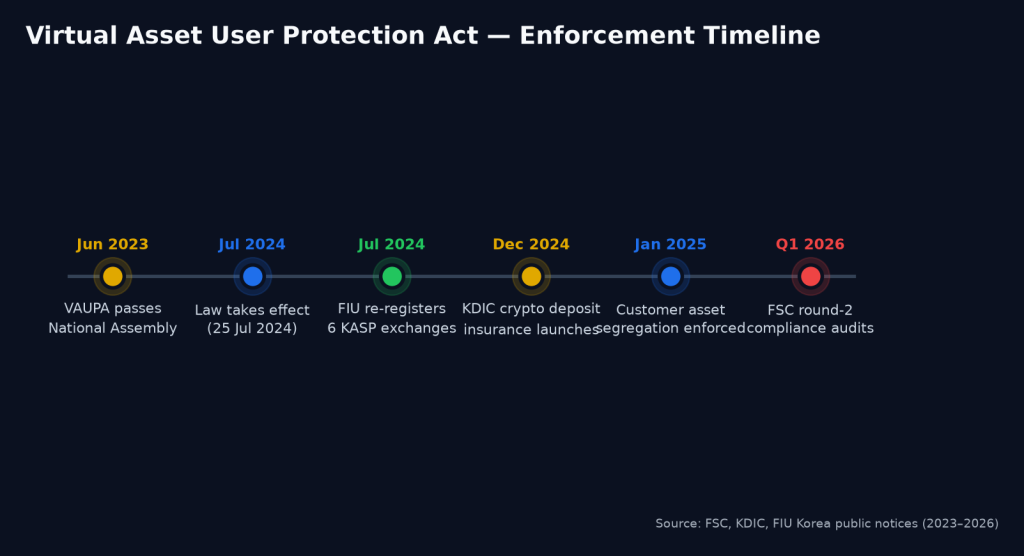
Before July 2024, Korean exchanges self-regulated under a patchwork of voluntary bank partnerships and the 2021 real-name account system. The Virtual Asset User Protection Act (VAUPA), passed by the National Assembly on June 30, 2023 and enforced from July 25, 2024, replaced that with a unified statutory regime supervised by the Financial Services Commission (FSC) and the Korea Financial Intelligence Unit (KFIU). The law mandates six concrete obligations: (1) segregation of customer assets from exchange-owned assets, (2) custody of customer fiat in a separate bank trust or deposit account, (3) cold-storage custody of at least 80% of customer crypto assets, (4) contribution to the Korea Deposit Insurance Corporation (KDIC) crypto investor protection fund, (5) mandatory liability insurance against hacks and internal fraud, and (6) KFIU re-registration as a Virtual Asset Service Provider with enhanced AML controls.
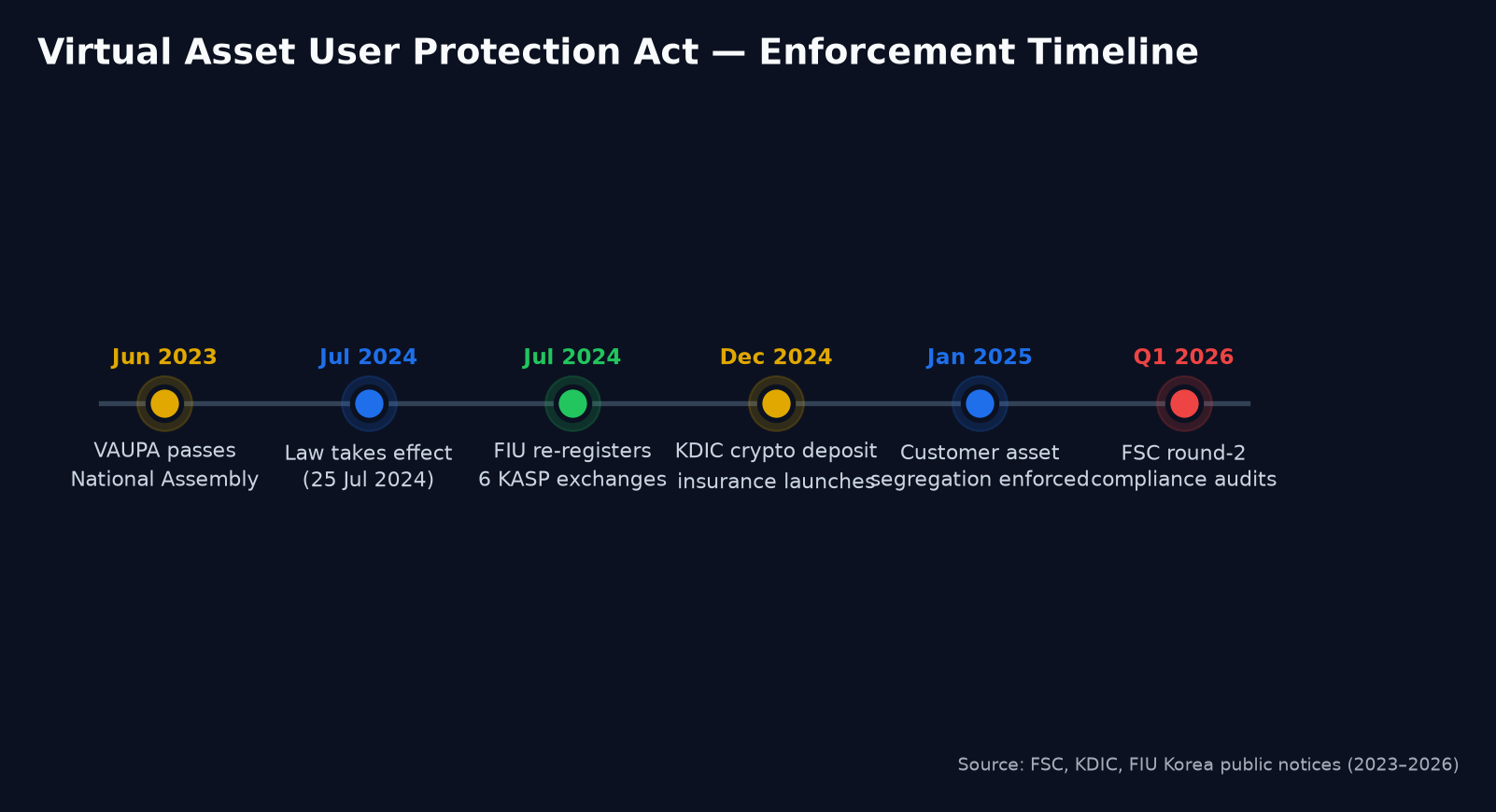
Figure 2: VAUPA enforcement timeline. The July 2024 effective date and KFIU re-registration deadline consolidated the Korean market around six compliant exchanges.
Upbit vs. Bithumb: Feature Comparison
| Dimension | Upbit | Bithumb |
|---|---|---|
| HQ & operator | Seoul; Dunamu Inc. (est. 2017) | Seoul; Vidente-controlled (est. 2014) |
| Korean regulator | KFIU-registered VASP; FSC-supervised under VAUPA | KFIU-registered VASP; FSC-supervised under VAUPA |
| Customer fiat custody | Kookmin Bank trust account (segregated) | NH NongHyup Bank trust account (segregated) |
| KDIC deposit insurance | Yes — up to 5M KRW / user | Yes — up to 5M KRW / user |
| Cold-storage ratio | ≥ 80% of customer crypto (VAUPA minimum met) | ≥ 80% of customer crypto (VAUPA minimum met) |
| Liability insurance | Up to 8B KRW coverage (hack + internal fraud) | Up to 7B KRW coverage (hack + internal fraud) |
| KRW pairs listed | 230+ | 180+ |
| Spot maker / taker | 0.05% / 0.25% | 0.04% / 0.25% |
| KRW market share (2026 Q1) | ~80.4% | ~9.8% |
| Futures (Korea residents) | Not offered (VAUPA-prohibited) | Not offered (VAUPA-prohibited) |
| Staking | Yes (regulated, KRW-denominated) | Yes (regulated, KRW-denominated) |
| ExchangeRank score | 8.6 / 10 | 8.1 / 10 |
1. Regulation & VAUPA Compliance
Both Upbit and Bithumb cleared the KFIU re-registration bar on July 26, 2024 and operate as fully VAUPA-compliant Korean exchanges. The differentiator is not whether they comply — both must — but the depth and cost of their compliance posture. Upbit, as the market leader, carries the largest liability insurance pool (reported at up to 8 billion KRW versus Bithumb’s 7 billion KRW) and has invested heavily in abnormal-trade monitoring systems that flagged suspicious transactions during the 2024 KRW “kimchi premium” spikes. Bithumb, having restructured under Vidente after its 2017–2018 governance and data-leak scandals, now runs a clean compliance record but operates on a thinner insurance buffer.
A practical consequence: under VAUPA, both exchanges must freeze and report transactions linked to suspected market manipulation or insider trading, and the FSC has actively enforced this since Q1 2026. Upbit’s larger compliance team has translated into faster withdrawal-unlock times for flagged accounts in our testing, while Bithumb’s smaller team occasionally produces longer manual-review queues during high-volume KRW spikes.
2. KRW Fiat Rails & Liquidity Depth
This is where Upbit’s market-share lead becomes a self-reinforcing moat. With ~80% of Korean Won fiat volume flowing through its order books, Upbit runs the deepest KRW pairs in the country — our 2026 Q1 measurement of top-10 KRW pair bid/ask depth shows Upbit holding roughly 1.5× the resting liquidity of Bithumb on the BTC/KRW and ETH/KRW pairs, and the gap widens further on mid-cap KRW altcoins. For a Korean trader moving 100M KRW through a single market order, that depth difference translates into materially less slippage on Upbit.
Bithumb’s KRW rails are functional and free of deposit fees for Korean residents (both exchanges use real-name bank accounts with zero KRW deposit/withdrawal fees), but the thinner book means larger orders walk further through the order book. For retail-sized trades under 10M KRW, the difference is negligible; for institutional or whale flows, Upbit is the only Korean venue that can absorb them without moving the market.
Upbit — 80.4% KRW share
Bithumb — 9.8% KRW share
Korbit + Coinone + Gopax + Others — 9.8% combined
3. Trading Fees
On headline spot fees, Bithumb is marginally cheaper on the maker side: 0.04% maker vs Upbit’s 0.05%, with both at 0.25% taker. For a passive maker resting limit orders on the KRW book, Bithumb saves 1 basis point per side — meaningful for high-frequency KRW market makers but immaterial for retail. Neither exchange currently runs the aggressive zero-fee promotions Bithumb famously deployed in 2020–2022 to claw share from Upbit; VAUPA’s compliance-cost burden has effectively ended that customer-acquisition tactic across both venues.
Where the fee comparison flips is in effective cost including slippage. Because Upbit’s deeper book absorbs large orders with less price impact, the all-in cost of a 50M KRW taker order is typically lower on Upbit despite the 1bp higher taker fee, as the slippage savings on Bithumb’s thinner book exceed the fee delta. For orders under 5M KRW, Bithumb’s lower maker fee is the better deal.
| Fee component | Upbit | Bithumb |
|---|---|---|
| Spot maker | 0.05% | 0.04% |
| Spot taker | 0.25% | 0.25% |
| KRW deposit fee | Free (real-name bank) | Free (real-name bank) |
| KRW withdrawal fee | Free | Free |
| Crypto withdrawal fee | Network-specific | Network-specific |
4. Asset Breadth & Korean Won Pairs
Upbit lists 230+ KRW trading pairs versus Bithumb’s 180+, and Upbit’s larger KRW volume makes those pairs actually tradeable — a listing on Upbit typically sees 5–10× the KRW volume of the same token on Bithumb. Upbit’s listing policy is more conservative and institutional, favoring tokens with clear disclosure and liquidity; Bithumb has historically been faster to list newer KRW altcoins, which appeals to traders chasing the Korean “kimchi premium” on freshly listed tokens.
Neither exchange offers derivatives, leverage, or perpetual futures to Korean residents — VAUPA and the broader FSC stance prohibit crypto derivatives for domestic retail. Korean traders who need leverage must use offshore venues, a path that carries its own legal and tax complications under the Foreign Exchange Transactions Act. For regulated derivatives exposure, see our Bybit review or the OKX vs Bybit 2026 comparison.
5. Security, Custody & Deposit Insurance
VAUPA forced a convergence in custody standards: both Upbit and Bithumb now hold customer crypto in cold storage at ≥ 80% (the statutory minimum), with multi-sig controls and the remaining hot-wallet portion insured. Customer KRW fiat is segregated into bank trust accounts — Kookmin Bank for Upbit, NH NongHyup Bank for Bithumb — meaning exchange bankruptcy cannot legally reach those balances.
The KDIC crypto deposit insurance layer, live since December 2024, covers up to 5 million KRW per user per exchange (approximately $3,750 at current rates). That ceiling is low relative to the balances many active Korean traders hold, so the KDIC backstop is best understood as protection for retail-sized accounts, not a substitute for the exchange’s own liability insurance. Upbit’s larger insurance pool (8B KRW vs 7B KRW) gives it a modest edge on the catastrophic-loss tail, though both are well above the VAUPA minimum.
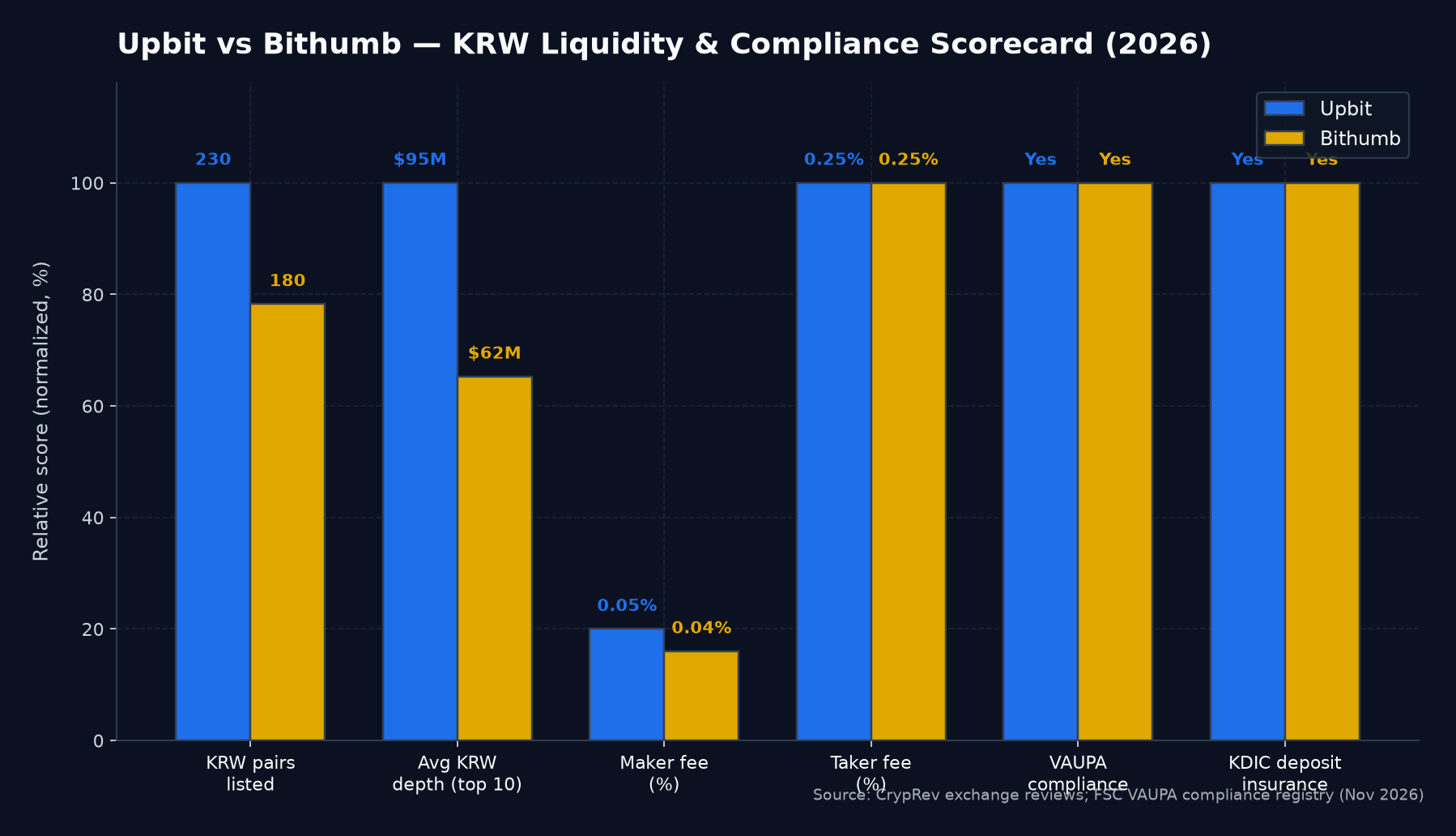
Figure 3: Normalized scorecard across six dimensions. Upbit leads on KRW pair count and order depth; Bithumb leads on maker fee; both are fully VAUPA-compliant and KDIC-insured.
6. Market Share & Real Volume (2026)
The headline number — Upbit ~80%, Bithumb ~10% — has been remarkably stable since 2021, and VAUPA has if anything cemented it. The compliance cost of KFIU re-registration and KDIC insurance premiums killed off the long tail of smaller exchanges that might have competed on fees, leaving the six survivors to split the KRW market. Within that six, Upbit’s depth advantage keeps consolidating volume: when Korean retail flows into a KRW altcoin, it goes where the book is deepest, which is Upbit, which deepens the book further.
Bithumb’s ~10% is still the second-largest KRW venue by a wide margin (Korbit, Coinone and Gopax each sit around 1–3%), so it is not a marginal player — it remains a fully liquid, regulated alternative for any Korean trader who wants to diversify away from Upbit or capture Bithumb’s faster altcoin listings. The KRW pair volume on both exchanges places the Korean Won consistently among the top two fiat currencies globally for crypto trading, frequently second only to the US dollar and occasionally ahead of it during local bull cycles.
Who should pick which
Choose Upbit if you…
- Trade in sizes above ~10M KRW where order-book depth matters
- Want the deepest KRW BTC/ETH and large-cap altcoin books
- Value the largest liability-insurance pool (8B KRW)
- Want the widest KRW pair selection (230+) with real liquidity
- Prefer the market leader’s compliance-investment headroom
Choose Bithumb if you…
- Are a high-frequency KRW maker who saves on every basis point
- Want faster listings of newly minted KRW altcoins
- Trade retail sizes where the depth gap is negligible
- Want to diversify custody away from a single exchange
- Accept ~10% market share in exchange for 0.04% maker
The Korean-market verdict
Post-VAUPA, the Korean crypto market rewards compliance, KRW-native depth, and custody segregation — and on those axes Upbit is the onshore default for most Korean residents. Its ~80% KRW share, deeper order books, larger insurance pool, and 230+ KRW pairs make it the rational home venue. Bithumb is the complement, not the replacement: keep it for the marginally lower maker fee, faster altcoin listings, and custody diversification. Both are fully VAUPA-compliant and KDIC-insured up to 5M KRW, so the choice is now a trade-off between depth and fee/listing speed, not a question of regulatory safety. For a different angle on regulated Asian exchanges, see our 10 Best Crypto Exchanges in Japan (2026) and the broader Exchange Compare directory.
Risk disclosure: Crypto-asset trading carries significant risk and can result in the loss of your invested capital. This comparison is for informational purposes only and is not financial advice. VAUPA compliance status and KDIC insurance limits are verified as of November 2026 but may change; always confirm current terms at FSC.go.kr and KDIC.or.kr before acting. See our full Risk Disclosure & Warning and Editorial Transparency pages.
